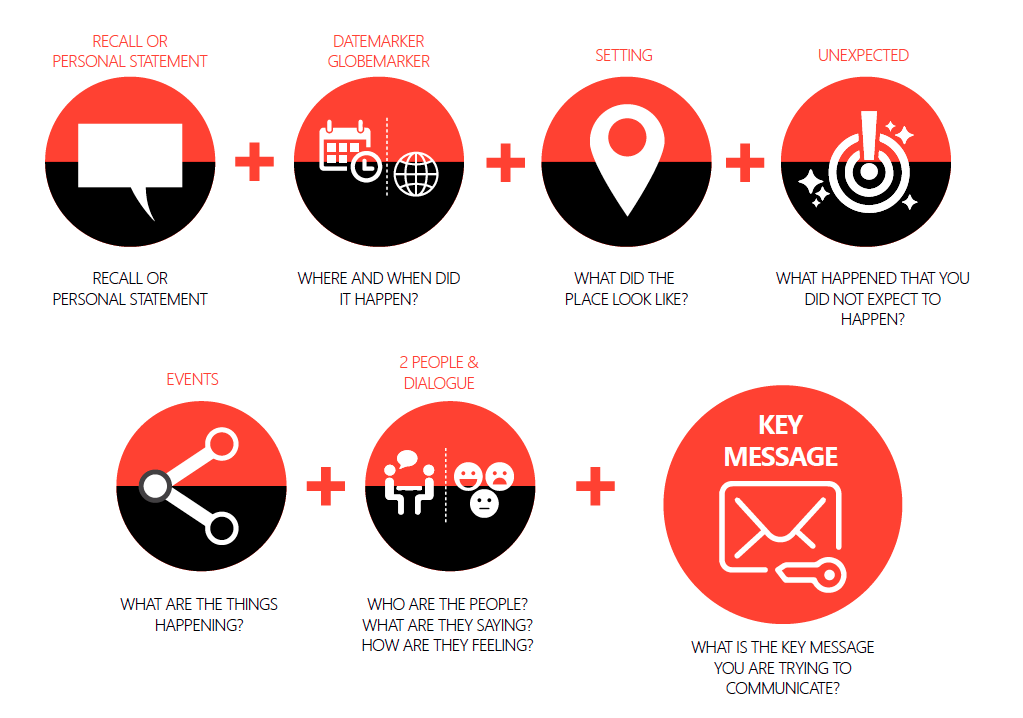
For our purposes, in its most basic form, a story is someone's description of an event (or a sequence of events) that either has occurred or may occur at a particular place and time, and which features one or more characters who take action for a particular purpose. In other words, a story is about something that has happened or which might happen. Many story experts are unhappy with this practical definition of a story because to their way of thinking, it doesn't acknowledge the sheer beauty and intricacy of quality stories. And they are right.
This definition does not deal with what makes a good story, only with the fundamentals of a story, in particular one with a business setting. There are some basic things to look out for when you're trying to spot a story:
Case studies Business case studies are sometimes stories, but often they are more like an expansion of the following three bullet points: •
The problem: the business issue that is being addressed
• The implementation: what is actually done
• The results: how the business issue is resolved or the improvements that are made.
For example, when addressing implementation, the case study will just provide lots of extra detail on this point, things like:
• Ran process-improvement sessions across all levels of the organisation using the results • Implemented process-improvement ideas in a small number of locations
• Analysed results to understand impact. Often, this will involve lots of numbers and stats.
So, in regard to the implementation example above, there might be a statement of the number of customers surveyed, the number who responded, the number of staff sessions run, the number of attendees, the number of ideas generated, etc., etc. The statistics are normally ramped up even more when it comes to the results section that explains the impact these initiatives had. This is not to say that case studies structured like this aren't useful, just that they do not normally contain stories.
ACTION
Convert a Case Study in to a Story and submit to benj@narrative.com.sg
Sales professionals often apologise for taking up a customer’s time, especially when speaking to busy healthcare teams. While intended as empathy, this habit can undermine credibility and position the seller as an interruption rather than a partner.
This piece explores the difference between acknowledging busyness and apologising for it—and why confident, respectful storytelling builds stronger professional authority.
Empathy makes you sound kind. Resonance makes you sound credible. In this article, I unpack a real sales role-play to show why naming a problem isn’t enough — you must illuminate what’s at stake.